Friday, 18 April 2025

An Exploration of Courage: The Heart Unmasked

    Courage, often depicted as a heroic act on a battlefield, is far more nuanced and pervasive. It's not merely the absence of fear, but the triumph over it, the resolute step forward despite its chilling presence. It's the quiet strength that allows us to face adversity, embrace vulnerability, and pursue our convictions, even when the path ahead is shrouded in uncertainty.  

    Courage isn't reserved for extraordinary circumstances; it's woven into the fabric of everyday life. It's the child who stands up to a bully, the artist who shares their work with the world, the individual who chooses honesty over expediency. It's the willingness to confront our own limitations and push beyond our comfort zones.

THE MANY FACETS OF COURAGE:

    Courage manifests in various forms, each reflecting a unique aspect of the human spirit:  

  • Physical Courage: The ability to confront physical danger or pain. This is often what we traditionally associate with courage, but it's only one facet.
  • Moral Courage: The strength to stand up for one's beliefs, even in the face of social pressure or opposition. This involves acting according to one's conscience, regardless of the consequences.  
  • Emotional Courage: The willingness to embrace vulnerability, to share our feelings, and to connect with others on a deeper level. This involves facing the risk of rejection or hurt.
  • Intellectual Courage: The openness to challenge established ideas and explore new perspectives. This involves questioning assumptions and embracing intellectual risk.  
  • Resilience: the ability to bounce back from adversity. Courage is shown when one continues to move forward, even after setbacks.  

CULTIVATING COURAGE:

    Courage is not an innate trait; it's a skill that can be developed and strengthened over time. Here are some ways to cultivate courage:  

  • Facing Fears Gradually: Start by confronting small fears, gradually building confidence and resilience.  
  • Setting Realistic Goals: Break down large goals into smaller, manageable steps, making them less intimidating.  
  • Practicing Mindfulness: Cultivating awareness of our thoughts and emotions, allowing us to manage fear and anxiety.  
  • Seeking Support: Surrounding ourselves with supportive people who encourage and inspire us.  
  • Embracing Vulnerability: Recognizing that vulnerability is not a weakness, but a strength, and allowing ourselves to be open and authentic.  
  • Learning from Failure: Viewing failure as an opportunity for growth and learning, rather than a setback.  
  • Acting with Purpose: Aligning our actions with our values and beliefs, giving us a sense of purpose and direction.  

THE RIPPLE EFFECT OF COURAGE:

    Courage is contagious. When we witness acts of courage, we are inspired to be courageous ourselves. It creates a ripple effect, transforming individuals and communities. It allows us to overcome obstacles, achieve our dreams, and create a more just and compassionate world.

    In a world that often demands conformity and safety, courage is the spark that ignites change. It's the heart unmasked, the spirit unfettered, and the unwavering belief in the power of the human spirit to overcome any challenge. Let us not overlook the quiet strength that resides within each of us. Courage is not a finite resource reserved for a select few; it is a muscle we can all develop, one brave act at a time. It is in these everyday moments of facing our fears, speaking our truth, and persevering through adversity that the true essence of courage shines through, illuminating our lives and the lives of those around us.

REFERENCES – accessed as at 16 to 18 April 2025

Courage | Authentic Happiness - University of Pennsylvania

Courage isn't always loud: The silent strength of daily battles | The Daily Star

Courage: An Essential Virtue for Authentic Living - Positive Psychology

Strategies Necessary for Moral Courage | OJIN - The Online Journal of Issues in Nursing

The Courage to Lead: Activating Four Types of Courage for Success - TEPSA

Courage: An Essential Virtue for Authentic Living - Positive Psychology

Harwood Prize for Intellectual Courage - AIER

How to cultivate courage and make fear your friend - Chasing Wonder


DISCLAIMERThis article has been written with approximately 20% aid from AI (Gemini & Copilot) 


Sunday, 6 April 2025

Integridad: Ang Ubod ng Tunay na Pagkatao

Ang integridad ang pundasyon kung saan itinayo ang tiwala, respeto, at pagiging tunay. Ito ay isang katangian na higit pa sa indibidwal na mga gawa at kumakatawan sa pagkakahanay ng mga pagpapahalaga, salita, at gawa ng isang tao. Nakaugat sa katapatan, pagiging maaasahan, at moral na tapang, ang integridad ang siyang gabay natin sa mga hamon at desisyon sa buhay.

Sa pinakapuso nito, ang integridad ay tungkol sa paggawa ng tama kahit walang nakatingin. Ang panloob na pangakong ito na itaguyod ang mga prinsipyo ng etika ay nagpapakita ng pagiging pare-pareho at tunay. Ang mga taong nagtataglay ng integridad ay nakakakuha ng respeto ng iba dahil sila ay kumikilos nang may katapatan at tumatangging ikompromiso ang kanilang mga pamantayang moral, kahit na sa ilalim ng presyon.

Ang integridad ay nahahayag sa ilang mga paraan:
  • Katapatan: Pagsasabi ng totoo at pagiging tapat sa komunikasyon
  • Pagiging Maaasahan: Pagtupad sa mga pangako at pagiging mapagkakatiwalaan
  • Pagiging Patas: Pakikitungo sa iba nang may pagkakapantay-pantay at katarungan, anuman ang mga kalagayan
  • Pananagutan: Pagtanggap ng responsibilidad para sa sariling mga gawa at ang kanilang mga resulta
Ang kahalagahan ng integridad ay hindi lamang limitado sa indibidwal na karakter; hinuhubog nito ang mga organisasyon, komunidad, at lipunan. Sa mga lugar ng trabaho, ang integridad ay nagtataguyod ng kultura ng tiwala at pagtutulungan. Ang mga namomonu na nagpapakita ng integridad ay nagbibigay-inspirasyon sa kanilang mga koponan, nagpapalakas ng moral, at nagpapatibay sa katatagan ng organisasyon. Sa mga relasyon, pinapalalim ng integridad ang mga ugnayan, nagtataguyod ng pagkakaunawaan, at nagpapatibay sa pangako.

Gayunpaman, ang pagpapanatili ng integridad ay hindi walang mga hamon. Ang mga tukso, takot sa paghuhusga, o personal na pakinabang ay maaaring sumubok sa ating katatagan. Ang paglampas sa mga hadlang na ito ay nangangailangan ng pagkilala sa sarili, tapang, at isang pangako sa personal na paglago. Sa pamamagitan ng pagmumuni-muni sa ating mga pagpapahalaga at pagbibigay-priyoridad sa pangmatagalang epekto kaysa sa panandaliang mga benepisyo, mapapatibay natin ang ating integridad at mamuhay nang may layunin at pagiging tunay.

Sa isang mundo na madalas pinahahalagahan ang kaginhawahan kaysa sa prinsipyo, ang integridad ay nananatiling isang tanglaw ng pag-asa at gabay. Ipinapaalala nito sa atin ang kahalagahan ng pananatiling tapat sa ating mga pagpapahalaga, paninindigan sa harap ng kahirapan, at pagkilos nang may kabaitan at habag. Sa huli, ang integridad ay hindi lamang isang katangian kundi isang paraan ng pamumuhay – isang pangako sa pamumuhay nang naaayon sa kung ano ang mabuti, patas, at makatarungan.

In conclusion, integrity is not merely a moral ideal; it is a way of life. It is a guiding light that shapes our decisions, actions, and interactions with others. Whether in personal, professional, or societal contexts, integrity remains a timeless and invaluable virtue. By embracing integrity, we not only elevate ourselves but also contribute to a world grounded in trust, respect, and ethical values.

NOTEMy first attempt at writing in Tagalog - hope it makes sense. Abangan ang susunod na kabanata. 

Saturday, 1 March 2025

This is Our Earth, Our World, Ourselves.

This is our only Earth, our world. A simple phrase, yet as a geoscientist, it echoes a profound truth: we bear a timeless responsibility for the Earth and its inhabitants. But how do we truly claim this world as ours, beyond mere ownership? It begins with an inward journey, a fundamental understanding that our capacity for external change is directly linked to our internal state.

Consider this: can a turbulent mind truly foster peace in the world? Can a heart burdened with self-doubt truly extend compassion to others? Before we can heal the planet, we must first heal ourselves. Before we can extend a hand to a struggling neighbour, we must first offer kindness to the internal struggles within.

Imagine a garden choked with weeds. To cultivate vibrant flowers, we must first clear the debris. Similarly, we cannot purify our rivers if our minds are polluted with negativity. We cannot protect the rainforest if our hearts are consumed by internal conflict.

The spectre of global conflict, the chilling reality of nuclear power, has shown us the grim potential of collective destruction. Yet, we struggle to find a path to collective harmony. But while grand solutions elude us, individual action remains potent. We can begin by cultivating a culture of dignity, honouring our own inherent worth and extending that same respect to every person we encounter.

This isn't about lofty ideals; it's about practical steps. It's about pausing before reacting with anger, choosing empathy over judgment, and recognising the shared humanity that binds us. By tending to the garden of our own souls, we create a ripple effect, fostering a world where both people and nature can flourish.

Let us not simply claim this world as ours but actively create a world worthy of that claim!


Friday, 28 February 2025

Motels - Highway Stop Overs

Someone once said, 'The road is always better than the motel.' It's a sentiment that, upon reflection, unlocks a profound truth about a life well-lived. In my youth, like many, I chased aspirations, believing that reaching them would bring lasting satisfaction. But I soon learned that life is a continuous pursuit. Each achieved goal, a 'motel,' offers only a brief respite, a temporary pause on the endless road of self-fulfillment.

True creative living thrives on motion, on constant movement away from stagnation. The journey itself, the very act of trying, is where the true happiness lies. As an amateur photographer (see: JPLlorca), the thrill isn't the albums or gallery display, but the moment of capturing the perfect shot. For me as a geologist, this road has taken many forms – the field exploration of minerals, the geological search and researches of precious metals, the countries and places visited, the people and multi-cultural experiences, and the lecture platform. Each 'motel' along these paths offered a moment for reflection, but also served as a springboard for new adventures.

The beauty of this journey is amplified when we travel not just through the external world, but also within the landscapes of our minds and spirits. We must diligently clear the dead ends of negativity, ensuring our internal compass points towards growth. The anticipation of self-fulfillment, the unwavering belief in our potential, transforms the road ahead into a vista of boundless possibility. Each step, each challenge overcome, strengthens the prospect of our greatest achievement.

Tuesday, 4 February 2025

Onion Skinned?

In today’s social media freedom, we know that some people are easily offended by perceived slights, requiring others to constantly monitor their words and actions.  This hypersensitivity often stems from low self-esteem.  Those with a fragile sense of self interpret seemingly innocuous remarks or actions as personal attacks, while individuals with healthy self-esteem are generally unfazed by such perceived slights.  Even genuine criticism, though potentially painful, has a far less devastating impact on someone with a strong sense of self-worth.  Conversely, those plagued by self-doubt and insecurity are prone to jealousy and perceive threats to their ego where none exist, often exaggerating the impact of even legitimate criticism.

Just as our physical bodies need the protective layer of skin, so too do our egos require a degree of resilience.  While a completely impenetrable shell would be detrimental, preventing us from experiencing the world fully, a lack of any protective layer leaves us vulnerable.  Many people navigate life with an overly sensitive "ego skin," reacting strongly to even minor perceived offences. They need to develop emotional resilience – a thicker "skin" – to deflect petty slights and perceived threats.

This resilience is built through cultivating self-esteem and developing a more positive self-image.  A physically strong person is less threatened by minor dangers than a weaker individual.  Similarly, a strong ego, bolstered by healthy self-esteem, is less likely to be threatened by innocent remarks or actions.  By building self-esteem, individuals can develop the emotional fortitude needed to navigate social interactions with greater confidence and less vulnerability.

Friday, 2 August 2024

First Journey to Kabul, Afghanistan

NOTES FROM MY DIARY


30 April 2014 @ Melbourne

Today, I embarked on a journey to Dubai, the first step in obtaining my Afghan visa where I am to work as Senior Geologist for the USAID’s project called MIDAS (Mining Investment and Development for Afghan Sustainability).

My flight, Singapore Airlines, SQ408, from Melbourne to Dubai, was scheduled to depart at 6:20 PM.

The morning was a flurry of activity spent finalizing travel preparations. Telly kindly brought Ampy to work while I finalized my packing. After sending a few emails and relocating the Apple MAC computer from the study to the studio, Telly and Ampy returned to drive me to Tullamarine Airport. Thankfully, I had completed the online check-in the previous evening, streamlining the airline departure process.

Everything went smoothly at the airport; check-in was hassle-free, and I boarded the plane, securing my seat in 57D. Unfortunately, the flight was far from peaceful. A family – a mother, a boisterous four-year-old daughter, a crying two-year-old son, and a grandmother – was seated nearby. The constant cries of the young child were particularly disruptive, and the situation was further compounded by the child's parents' request to use the empty seats beside me. Despite the inconvenience, I couldn’t refuse. Unfortunately, the disruptions continued throughout the night, including the unpleasant odour of multiple diaper incidents.

Despite the noise, I managed to enjoy the in-flight meals and passed the time by watching "I, Frankenstein" and "Jack Ryan: Shadow Recruit." However, the pilot's announcement of a 7-hour and 20-minute flight, longer than anticipated, cast a shadow over the smooth journey. This unexpected delay meant I would miss my connecting flight in Singapore. As scenarios raced through my mind, I resolved to build in at least two hours of layover time for future connecting flights to account for potential delays. For now, there was nothing to do but relax and hope for some sleep.


1 May 2014 @ Singapore – Layover

As expected, plane was delayed. The flight arrived in Singapore at 12:25 AM, and I exited the terminal around 12:35 AM. Panic set in when I realized my connecting flight's boarding time was at 12:10 AM! I braced myself for the inevitable chaos and headed to the information counter.

Anticipating potential travel chaos, to my astonishment, the agent informed me the gate was still open for my flight. Confused, as I hadn't seen SQ498 on the monitor, she directed me to Terminal 2, Gate E11.

The race against time began. I sprinted through Terminal 3, hopped on the Skytrain, and continued running towards Terminal 2. Grabbing a trolley was a lifesaver. The frantic dash to the gates felt like a high-stakes reality show (The Amazing Race), and I was the sole contestant that my body was screaming for mercy.

Miraculously, I arrived at the gate just as the last passengers were clearing security. Exhausted but elated, I boarded the plane and claimed my aisle seat, 57H. Unfortunately, my seat neighbour had a strong body odour, making for an unpleasant start to the flight.

I attempted to distract myself with movies but found little enjoyment in "Invisible Woman" and couldn't muster the enthusiasm for other options. Sleep became my only refuge.


Dubai, UAE

My flight arrived in Dubai on time at 4:45 AM. Navigating the massive airport, I spent ten minutes clearing immigration and customs, both of which were surprisingly hassle-free compared to my usual experiences. The process was far less stringent than I expected, with no forms to fill up or questioning by an immigration officer. The relaxed atmosphere was a pleasant surprise. A good sign to have a pleasant day ahead.

I took a taxi to the Le Meridien Airport Hotel, paying AED60. I arrived at the hotel by 8:00AM, and unfortunately, no rooms were available until 10 AM. While waiting, I recharged my Vodafone phone for AED50, giving me an AUD75.73 credit. I contacted Bismilla the travel agent at Skylink Travel who is arranging my visa. I also sent an SMS to update Ampy and Telly.

Waiting isn’t my strong suit, and the hours until the room check-in felt interminable. The constant Nokia ringtones in the lobby were grating. A Sony Xperia ad with dual SIM card caught my eye, a very tempting prospect.

After what felt like an eternity, I finally got a room at 10 AM, only to be disturbed by two false fire alarms caused by someone smoking in the stairwell. To top it off, I discovered an error on my newly issued visa: my birthplace was listed as Australia instead of the Philippines.

All of these, I say it is an initiation to working in a conflict zone – Afghanistan. I wonder what the future holds. I wish myself luck.


2 May 2014 - Dubai to Kabul

Today I take my first trip from Dubai to Kabul.

More to follow....  

Friday, 19 April 2024

The High Stakes of Sample Size in Ore Classification - How One Sample Can Impact Mine Profitability

Traditionally, a single sample can determine the fate of a large volume of material in a mine. This decision, often involving tonnes of ore or waste, hinges on the accuracy of that one sample. This reliance on a limited data point presents a significant cost risk.

To illustrate, consider the impact of sample size on mine tonnage. During my time as Chief Geologist at the Longos Gold Mine, the open pit in Paracale, a single sample represented 7 tonnes of in-situ material. A misclassification could lead to incorrectly categorizing this material, resulting in lost revenue (if ore is classified as waste) or unnecessary processing costs (if waste is classified as ore).

Quantifying the Impact:

Let's consider the economic consequences of such a misclassification. Assuming the average gold content per tonne of ore is X grams (g) at a price of Y dollars per gram ($/g), the potential financial loss due to a misclassified 7-tonne batch would be:

  • Loss from discarded ore: (X g/tonne * 7 tonnes) * ($Y/g) = Z dollars
  • Additional processing cost for waste: (processing cost per tonne) * 7 tonnes = W dollars
  • The total potential cost (Z + W) highlights the importance of using an appropriate sample size to minimize misclassification risks.

Moving Forward: A Data-Driven Approach

This example highlights the high stakes associated with limited sample size. Implementing statistically robust sampling techniques, such as collecting multiple samples, can significantly reduce the economic risk impact of misclassification and improve overall mine profitability.

Wednesday, 9 October 2019

Are Diamonds Still Girls' Best Friend?


"Diamonds! Diamonds!
I don't mean rhinestones!
...
But square-cut or pear-shaped
These rocks don't loose their shape.
Diamonds are a girl's best friend."


The above lyrics composed by Jule Styne and sung by Marilyn Monroe still lingers on. Diamonds have always been said to be a girl’s best friend. But coming from a geoscience background, I believe it is a matter of popular perception that makes it their best friend of choice. 

Don’t get me wrong, I am not debasing diamonds. They are precious stones, and their value has stood the test of time. The gems properties are an excellent brilliant lustre, the hardest known mineral, priced and loved by most women… and some men. 

The question to ask is, “Is it rare?” The answer is “no.” Diamonds are commercially abundant. Good jewellery stores carry stocks of them. But, why does it have to be rare? Because rarity makes it worth having and truly precious. There are rare varieties like the Argyle pink and yellow diamonds. However, there is a jewel that is even rarer – ruby! This can be evidenced by browsing your local jewellery advertising brochures. What you will find in those brochures are diamond jewellery but not ruby jewellery. If there are any, it would say “created, man made or industrial” rubies. “Natural” rubies are indeed rare! 

My wife who is also a geologist, and quite knowledgeable on gemstones, if presented with a diamond and ruby, she would obviously take both. But, if made to choose one over the other, ruby is her definite choice. During my last trip to South Africa, I was told to buy her Tanzanites. Yes, tanzanite is another rare gem, found only in Tanzania, East Africa, thus proving her adeptness of gemstones. Another requirement is that the jewellery is to be set in platinum. Platinum is her choice of base setting as it is rarer, stronger and more valuable than gold. Now with choices of Ruby, Tanzanite in a platinum setting, the question is, “Are diamonds still a girl’s best friend?” You decide, the answer is obvious! 

Tanzanite
Natural Ruby
[Originally published at Mining Plus Telegraph, Issue 15 May 2011]

Data Management


It has been referred to in many publications that an organisation’s most important resource is its data. In recent years the worldwide exploration and mining industries has rigidly emphasised the need for QA/QC with the development of standard reporting codes to meet industry best practice. Understanding how data relates to information to form the big picture enables an organisation to make better decisions, improve process efficiencies, and lower overall operational costs. In today’s highly competitive market, without an adequate understanding of the importance of an organization’s data and its structures, it would be a challenge to enable effective decision-making and provide an overall view of what is happening, both within and outside the organization. 

Recently I read Russell L Ackoff’s book entitled “Re-Creating the Corporation: A Design of Organizations for the 21st Century.” In his book, Ackoff posited a tier, from top to bottom, of wisdom, understanding, information, knowledge, and data. He also estimated that on the average human mind consists of 40% data, 30% information, 20% knowledge and 10% understanding and almost no wisdom. Ackoff’s model can be viewed as a pyramid with wisdom on top. In Figure 1, I have taken Ackoff’s idea and expanded it to cover the data source, and omitted understanding, placing it as an encompassing behaviour to management of data.


Figure 1: DATA, PROCESSING & MANAGEMENT

It can be summarised that data is a collation of facts, data that has been analysed will give you information, the use of information will give you the knowledge, and the maximisation of this knowledge will result in wisdom. Furthermore, the increase in understanding can shed light on facts to obtaining knowledge, and through experience we can attain wisdom. 

The simple chart above shows the interrelationship between the different degrees of data and it is about filtering noise, reducing the flow to what is clear, clean and manageable as a corporate resource. These interrelationships are not as simple as portrayed in real life. It can be more complicated than a mere flow process. Consider the following observations made by Neil Fleming (Coping with a Revolution: Will the Internet Change Learning?, Lincoln University, Canterbury, New Zealand, 1996):

  • A collection of data is not information.
  • A collection of information is not knowledge.
  • A collection of knowledge is not wisdom.
  • A collection of wisdom is not truth.

Thus, a mere collection of data is not of full value to an organisation. In our consulting assignments, we at Mining Plus, have encountered from good to bad client databases at various stages of development. It is one of our core strengths to create, audit, manage and add value to our client’s most valuable resource; data that is truthful and validated. If your company deals with data, them come and see us. 

[Originally published at Mining Plus Telegraph, Issue 15 November 2010]


Sunday, 29 September 2019

My Inimitable Field Gear: No. 2


One of my favourite quotes, I used three decades ago in my opening for Speech Project No 4 at a Toastmasters Club, goes like this, “A stupendous creation surrounds us, with infinite form, infinite variety and infinite beauty. The more intense our awareness of this vast complexity, the more alive we are.”

We geologists are indeed very lucky, as it is in our education and professional practice to see a world in a grain of sand. How do we appreciate this? By using of a good hand lens.

While common folk step on, or kick a piece of rock, we geologists use hand lens to see the minerals that form them, the unique crystal system that identifies them, and think of the complicated processes that created them. There is so much to see and discover in a small piece of rock specimen, like the various textures, crystal shapes, and the play of light that gives brilliant colours. Helen Keller was once asked of what she thought was the worst calamity that could befall a person, she replied, “To have eyes and fail to see.”

Speaking of finding a world in a grain of sand, imagine the millions of people who've been to the beach many times, yet fail to see that every wet grain of beach sand is thinly coated with water and does not actually touch each other. This is the reason why beach sand is never ground to powder, no matter how much they are pounded by waves. “To be a geologist and fail to see? Nah… it never happens, we are equipped with a hand lens.

The hand lens has many names, like pocket lens/glass, magnifying glass, loupe, lens or 10X. Whatever called, its purpose is to aid our naked eyes to see things that are beyond our normal vision. With the many names, come the various types, styles, brand and prices. So what is the best lens for geologists? There is no one answer, but here are a few technical specifications I have used that proved to make a good choice.  I may be biased, but one lens that has travelled and grown old with me is my 10X and 20X Hastings Triplet, made by Bauch and Lomb (see photo).

Here are the things to look for: First, construction. The Hastings Triplet is built from three separate high quality lenses bounded together to form a compound lens. This compound lens provides very distinct image that is highly corrected for spherical aberrations. Second, lens quality. The lens should be of high quality material and polish, specially coated and corrected for chromatic distortion to give true colours. Third, magnification. This commonly comes in 7X, 10X, 14X and 20X. I prefer 10X as my prime all around lens as it gives me just the right detail and good field of view. Should there be a need to see finer crystal forms, then 20X comes in handy. Fourth, body construction. Should be rust proof or hard plastic. It is also best that the triplet lens is waterproof. Water should not get in between the lenses.

One more thing, when carrying your hand lens around your neck, the choice of lanyard is very important. For safety reasons, choose a lanyard that is breakable, not one so strong that when it gets caught will choke or even hang you to death. “No, I am not speaking through experience here, and don’t have the rope burns marks around my neck to prove it.”

[Originally Published in GeoFalcon, Issue No. 3, November 2013]

My Inimitable Field Gear: No. 1


We geologists could not perform our field tasks without the proper gear. In this column, we will try to unravel what are these essential items. A number of us to some extreme bring more than the essential items, and while others are on the minimalistic principle. Generally, we geologists love our field gear. Sometimes there is a hidden competition on who does have the latest and best gear. We look at colleagues with meticulous and googly eyes. Envious or proud of what we got. 


In this first series of articles, we bring you the humble whistle, yes, a whistle! I bet you not all of, even the most seasoned, field geologists carry a whistle. Why carry one? Is it essential in performing a geological task? Probably not, but, it could be a lifesaver and excellent for calling attention!

The humble whistle has louder decibels than a human voice, that it is still used in the underground mines by mine car transporters for signaling. 


A whistle produces a lovely musical tone… now I wonder if there are any geologists who can blow a melody using a whistle – then he or she should enlist for an audition in “Geologists Have Talent” – a forthcoming variety show. 


It is cheap, light weight… and it comes in all sorts of colours for your little geo-heart desires.

A cautionary statement is now in order. All of the above has been written with certain seriousness and pun. One geo-scientific skill required in practice is to be able to separate fact from fiction. Reading this article and succeeding articles in this series requires that skill. 


In the next series, we will look at the all-important geological hand lens.  Cheers! 

[Originally Published in GeoFalcon, Issue No 2, June 2013]

Sunday, 27 May 2018

In Search For Gold


Myanmar

19 May 2018, Saturday

It is a Saturday, a weekend for most to enjoy, a day of rest for some, but not for this old geologist who is working the field in search for that precious metal, gold.

After heavy rains yesterday, that marks the start of the monsoon season in Myanmar, we were able to head to do some field work. Yesterday, we sent a scout to assess the road accessibility to the outcrops. After a couple of hours, they came back reporting the river crossing had high water level with strong downstream flow that made it risky. Also, the summer long dried and dusty road is now saturated, muddy, slippery making the four-wheel drive veer off the road. Yesterday's field work was a write-off.  Today, however, the sun showed its face. We had quick breakfast and geared up, excited to see some good outcrops. 

We took the Toyota Land Cruiser up to the field camp in a village called Kame. The village of Kame looks like an old and humble village. I observed no televisions, computers or even smart phones! Houses were all constructed of hard wood with corrugated galvanised iron sheet roofs. Only very few houses had painted exteriors that are now cracked and faded. The houses are on stilts of about 3 to 4 metres above ground. The lower portion is used for storage of farm equipment and other amenities.  Around the village I noticed the rice paddies and peanuts laid out on a wicker mat for the sun to dry. Farming is their main livelihood.

At Kame, this is the end of the 4X4 ride. Looking back, the Toyota Land cruiser was a luxury ride and from this point on there are no longer accessible road by four-wheel drives. What lies ahead are old logging road, no longer maintained, that only motorbikes and water buffalo or cow drawn carts are able to trek. For us, it is a motor bike ride moving forward.

Each of us were given a motorbike and driver. We had a convoy of eight bikes. I am very impressed by these Chinese made Kenbo motorbikes. They were designed as city road bikes but are used by these experienced bike-drivers to the hilt!

These drivers know its mechanical limits, not to run them to destruction as it would cost several harvests to get a new one. These motorbikes can really take it, imagine carrying this 80Kg stubby geologist? During the uphill drive, you can hear the full throttle, loud rumble, see the bellowing smoke and feel the grumbling of a stressed-out engine.

The road was not forgiving to these motorbikes, there were uphill sections that it could not move forward due to the wet and slippery road. We had to walk these uphill stretches. Some downhill sections were deemed too dangerous that our drivers asked us to walk downhill as well. It was good to know they cared about their passengers.

There is no petrol station in the village, nor one nearby. What they have are villagers selling petrol in 750ml whisky bottles. To save on petrol, during downhill sections of the path, they switch-off the engine and glide downhill, just at it levelled and slowed down, they release the clutch that starts the engine once again. From petrol power to gravity power then back to petrol power. During the gravity power, we did not have any engine brake to count on and the speed is a tad faster. What an adrenalin cycle.  They know these paths very well indeed.

These motorbikes and skilled drivers safely brought us to the outcrops where we conducted our geological work. The details of this work and results is not covered in this journal, but in a separate field investigation report submitted to my employer.

Lunch, men ate first while the women and children watched and served by the side.  This made me feel uncomfortable and awkward. At home, we always eat together. We say a prayer before meals and partake on the food at the table. We enjoy each others' company that we always have extended meal time for conversations after meals. Meal time is part of our day that keeps us together as a family. Sharing and communicating. For these villagers, they may not have known any other that they keep this tradition. Not knowing of the complex political correctness and gender equality issues of the modern world, their lives are simple, content and happy.

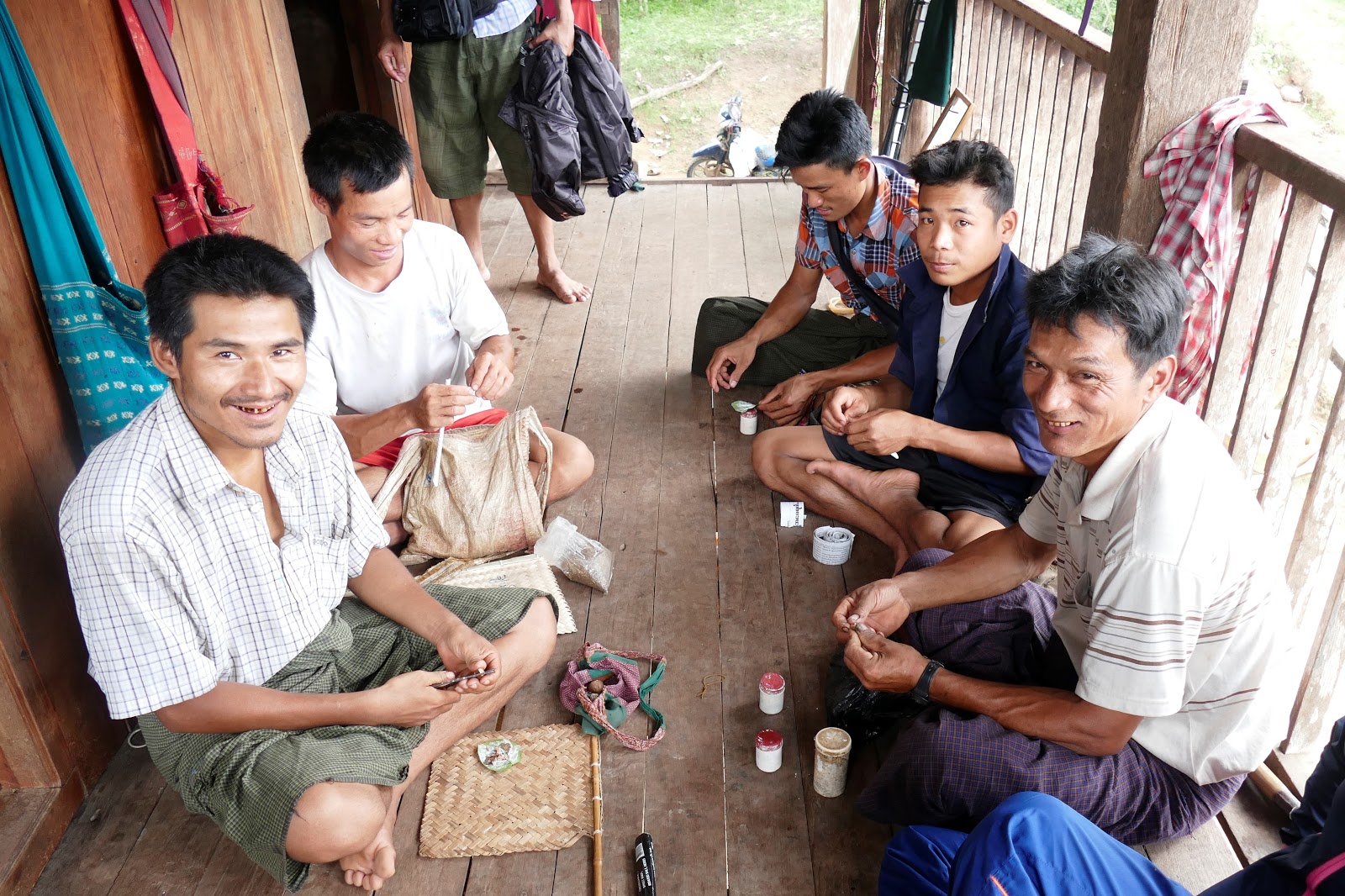
After lunch, the men gathered around sitting in a crossed legged fashion and individually prepared their betel nut chew. Some made their own cigarette from locally grown tobacco using old newspaper strips as wrapping. All the while I did not comment, just observed and took their photos. My mind was thinking how unhealthy or toxic inhaling the burnt chemicals from the newspaper ink. I was offered, but tactfully declined. I can see teasing in their eyes and smiles that knew I would not try.

We hit the trail, visited three other outcrops. Panned in two areas where both showed three and two colours respectively. That means we found three and two specs of very fine gold from the panning. I marked the locations with a GPS, took photographs, made some notes and headed back to Pinlebu. We found gold and called it a day!

Trip from Mandalay to Pinlebu Township

Myanmar
16 May 2018

We were driving from Mandalay to the township of Pinlebu, which took us a little more than 10 hours of travel, including lunch break and stopping for some field supplies.

With me were two company geologists and one government geologist from the Department of Geological Survey and Mineral Exploration (DGSE). A field manager who handles the logistics and money matters, and a driver. There were the six of us in one vehicle.

Our service vehicle was a Toyota Land Cruiser (V6 engine), a battered vehicle yet sturdy and field worthy. Being their guest, I was asked to seat in front. The four other companions were cramped at the back seat. Instinctively I wore my seat belt, but the rest did not bother. I could have asked them to, but I realised there is not enough seat belts at the back to cover all four passengers, there were on three seat belts. Anyway, I kept quiet and made sure that I ceremoniously buckled-up for them to notice, even if just the driver. Over the trip's several stops of getting in and out of the vehicle, no avail.


Myanmar is a right-hand drive country; the vehicles travel on the right side of the road. Which means vehicles are driven from the left-hand side. Interestingly, it so happens our vehicle is a left-hand drive! Glancing around, I observed other vehicles, ours is not the only one. There is a fair percentage of licensed vehicles with steering wheel on the wrong side.

Riding in the front is much more comfortable than the pack at the back, especially for the long drive, but there are some tense moments along the way too. Seating in front makes me feel like a driver with no steering wheel - no control! Seeing the incoming traffic from the opposite side of a narrow road is terrifying. Towards the rural areas, the bitumen roads are single lane to cover both two-way traffic. I don't know what the road etiquette is on who gives way. Though when meeting an incoming vehicle, they drive half their vehicle on the bitumen and half on the unpaved shoulder. This system works, except that the clearance between the opposing vehicles are less than a foot. Lorries from opposite direction were speeding that does not seem to slow down, imposing their size against small vehicles to give them way. Several times my right foot reflexes made a breaking motion, stepping hard on the floor, jolting a realisation that there was no brake or a steering wheel to steer.

The long drive made me tired that I did dose off, only to be awaken several times by the sound and vibrations of a speeding by vehicle. After several of this wake-ups, I did not mind and left my faith to our skilled driver. At the end of the day, we arrived Pinlebu, a little bit anguished and importantly unscathed that I am able to write this journal.

One observation made during the long trip was, our driver opened his window and emptied his quarter full water bottle on to the street. I wondered to myself why? Then, he brought the empty water bottle to his lips and spat a red liquid into it. Then I realised he was chewing betel nut. This was done several times over the trip. Looking around, I also noticed another driver opened his window and skilfully spat out a jet stream of red liquid into the road. This has led me to question who is doing the right thing. Is it our driver who did not want to pollute, yet wastefully threw out clean drinking water? Or is it the driver who just spat on the ground without wasting water?

I am still battling for the best answer.