Sunday, 29 September 2019

My Inimitable Field Gear: No. 2


One of my favourite quotes, I used three decades ago in my opening for Speech Project No 4 at a Toastmasters Club, goes like this, “A stupendous creation surrounds us, with infinite form, infinite variety and infinite beauty. The more intense our awareness of this vast complexity, the more alive we are.”

We geologists are indeed very lucky, as it is in our education and professional practice to see a world in a grain of sand. How do we appreciate this? By using of a good hand lens.

While common folk step on, or kick a piece of rock, we geologists use hand lens to see the minerals that form them, the unique crystal system that identifies them, and think of the complicated processes that created them. There is so much to see and discover in a small piece of rock specimen, like the various textures, crystal shapes, and the play of light that gives brilliant colours. Helen Keller was once asked of what she thought was the worst calamity that could befall a person, she replied, “To have eyes and fail to see.”

Speaking of finding a world in a grain of sand, imagine the millions of people who've been to the beach many times, yet fail to see that every wet grain of beach sand is thinly coated with water and does not actually touch each other. This is the reason why beach sand is never ground to powder, no matter how much they are pounded by waves. “To be a geologist and fail to see? Nah… it never happens, we are equipped with a hand lens.”

The hand lens has many names, like pocket lens/glass, magnifying glass, loupe, lens or 10X. Whatever called, its purpose is to aid our naked eyes to see things that are beyond our normal vision. With the many names, come the various types, styles, brand and prices. So what is the best lens for geologists? There is no one answer, but here are a few technical specifications I have used that proved to make a good choice.  I may be biased, but one lens that has travelled and grown old with me is my 10X and 20X Hastings Triplet, made by Bauch and Lomb (see photo).

Here are the things to look for: First, construction. The Hastings Triplet is built from three separate high quality lenses bounded together to form a compound lens. This compound lens provides very distinct image that is highly corrected for spherical aberrations. Second, lens quality. The lens should be of high quality material and polish, specially coated and corrected for chromatic distortion to give true colours. Third, magnification. This commonly comes in 7X, 10X, 14X and 20X. I prefer 10X as my prime all around lens as it gives me just the right detail and good field of view. Should there be a need to see finer crystal forms, then 20X comes in handy. Fourth, body construction. Should be rust proof or hard plastic. It is also best that the triplet lens is waterproof. Water should not get in between the lenses.

One more thing, when carrying your hand lens around your neck, the choice of lanyard is very important. For safety reasons, choose a lanyard that is breakable, not one so strong that when it gets caught will choke or even hang you to death. “No, I am not speaking through experience here, and don’t have the rope burns marks around my neck to prove it.”

[Originally Published in GeoFalcon, Issue No. 3, November 2013]

My Inimitable Field Gear: No. 1


We geologists could not perform our field tasks without the proper gear. In this column, we will try to unravel what are these essential items. A number of us to some extreme bring more than the essential items, and while others are on the minimalistic principle. Generally, we geologists love our field gear. Sometimes there is a hidden competition on who does have the latest and best gear. We look at colleagues with meticulous and googly eyes. Envious or proud of what we got. 


In this first series of articles, we bring you the humble whistle, yes, a whistle! I bet you not all of, even the most seasoned, field geologists carry a whistle. Why carry one? Is it essential in performing a geological task? Probably not, but, it could be a lifesaver and excellent for calling attention!

The humble whistle has louder decibels than a human voice, that it is still used in the underground mines by mine car transporters for signaling. 


A whistle produces a lovely musical tone… now I wonder if there are any geologists who can blow a melody using a whistle – then he or she should enlist for an audition in “Geologists Have Talent” – a forthcoming variety show. 


It is cheap, light weight… and it comes in all sorts of colours for your little geo-heart desires.

A cautionary statement is now in order. All of the above has been written with certain seriousness and pun. One geo-scientific skill required in practice is to be able to separate fact from fiction. Reading this article and succeeding articles in this series requires that skill. 


In the next series, we will look at the all-important geological hand lens.  Cheers! 

[Originally Published in GeoFalcon, Issue No 2, June 2013]

Sunday, 27 May 2018

In Search For Gold


Myanmar

19 May 2018, Saturday

It is a Saturday, a weekend for most to enjoy, a day of rest for some, but not for this old geologist who is working the field in search for that precious metal, gold.

After heavy rains yesterday, that marks the start of the monsoon season in Myanmar, we were able to head to do some field work. Yesterday, we sent a scout to assess the road accessibility to the outcrops. After a couple of hours, they came back reporting the river crossing had high water level with strong downstream flow that made it risky. Also, the summer long dried and dusty road is now saturated, muddy, slippery making the four-wheel drive veer off the road. Yesterday's field work was a write-off.  Today, however, the sun showed its face. We had quick breakfast and geared up, excited to see some good outcrops. 

We took the Toyota Land Cruiser up to the field camp in a village called Kame. The village of Kame looks like an old and humble village. I observed no televisions, computers or even smart phones! Houses were all constructed of hard wood with corrugated galvanised iron sheet roofs. Only very few houses had painted exteriors that are now cracked and faded. The houses are on stilts of about 3 to 4 metres above ground. The lower portion is used for storage of farm equipment and other amenities.  Around the village I noticed the rice paddies and peanuts laid out on a wicker mat for the sun to dry. Farming is their main livelihood.

At Kame, this is the end of the 4X4 ride. Looking back, the Toyota Land cruiser was a luxury ride and from this point on there are no longer accessible road by four-wheel drives. What lies ahead are old logging road, no longer maintained, that only motorbikes and water buffalo or cow drawn carts are able to trek. For us, it is a motor bike ride moving forward.

Each of us were given a motorbike and driver. We had a convoy of eight bikes. I am very impressed by these Chinese made Kenbo motorbikes. They were designed as city road bikes but are used by these experienced bike-drivers to the hilt!

These drivers know its mechanical limits, not to run them to destruction as it would cost several harvests to get a new one. These motorbikes can really take it, imagine carrying this 80Kg stubby geologist? During the uphill drive, you can hear the full throttle, loud rumble, see the bellowing smoke and feel the grumbling of a stressed-out engine.

The road was not forgiving to these motorbikes, there were uphill sections that it could not move forward due to the wet and slippery road. We had to walk these uphill stretches. Some downhill sections were deemed too dangerous that our drivers asked us to walk downhill as well. It was good to know they cared about their passengers.

There is no petrol station in the village, nor one nearby. What they have are villagers selling petrol in 750ml whisky bottles. To save on petrol, during downhill sections of the path, they switch-off the engine and glide downhill, just at it levelled and slowed down, they release the clutch that starts the engine once again. From petrol power to gravity power then back to petrol power. During the gravity power, we did not have any engine brake to count on and the speed is a tad faster. What an adrenalin cycle.  They know these paths very well indeed.

These motorbikes and skilled drivers safely brought us to the outcrops where we conducted our geological work. The details of this work and results is not covered in this journal, but in a separate field investigation report submitted to my employer.

Lunch, men ate first while the women and children watched and served by the side.  This made me feel uncomfortable and awkward. At home, we always eat together. We say a prayer before meals and partake on the food at the table. We enjoy each others' company that we always have extended meal time for conversations after meals. Meal time is part of our day that keeps us together as a family. Sharing and communicating. For these villagers, they may not have known any other that they keep this tradition. Not knowing of the complex political correctness and gender equality issues of the modern world, their lives are simple, content and happy.

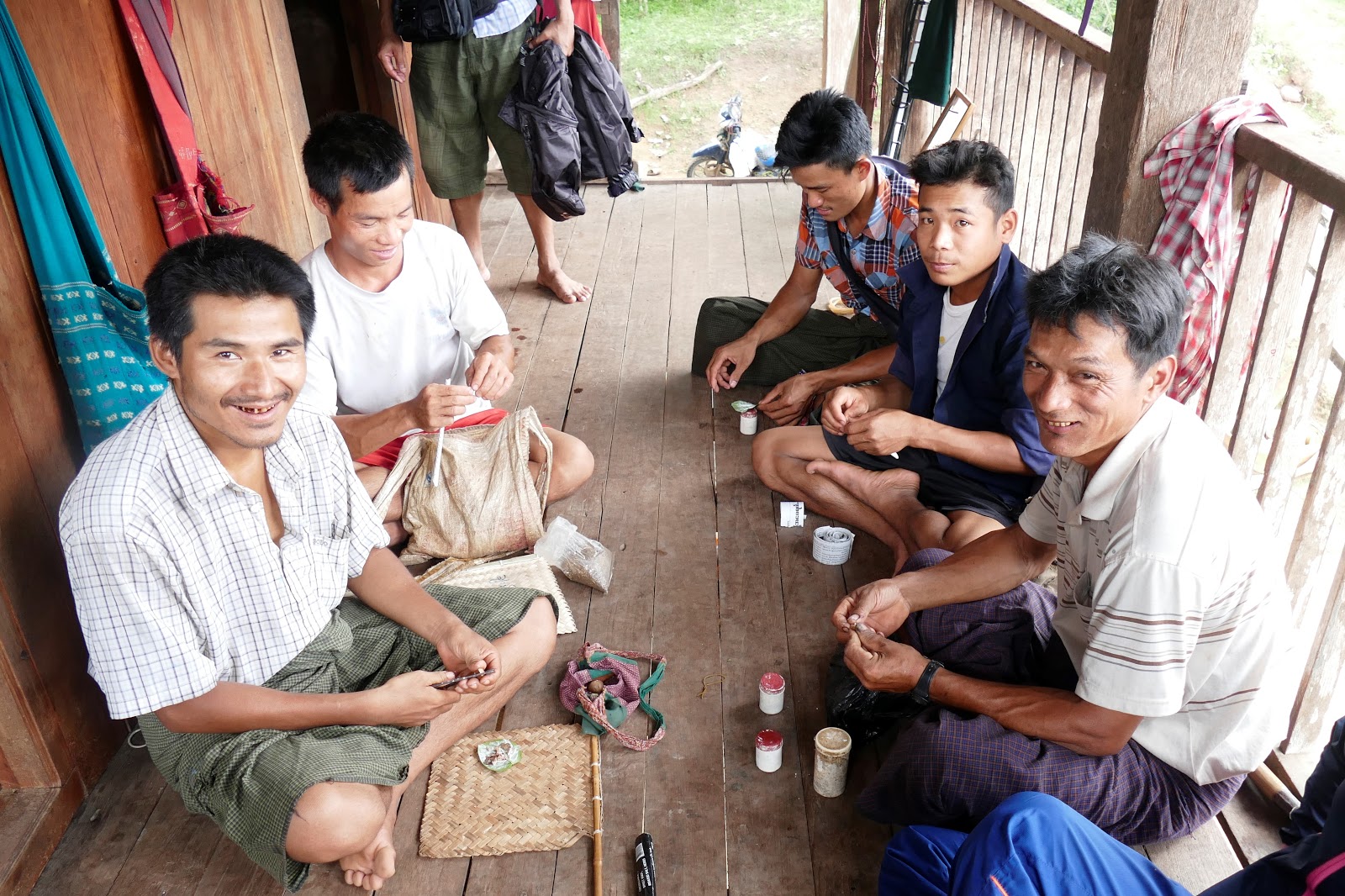
After lunch, the men gathered around sitting in a crossed legged fashion and individually prepared their betel nut chew. Some made their own cigarette from locally grown tobacco using old newspaper strips as wrapping. All the while I did not comment, just observed and took their photos. My mind was thinking how unhealthy or toxic inhaling the burnt chemicals from the newspaper ink. I was offered, but tactfully declined. I can see teasing in their eyes and smiles that knew I would not try.

We hit the trail, visited three other outcrops. Panned in two areas where both showed three and two colours respectively. That means we found three and two specs of very fine gold from the panning. I marked the locations with a GPS, took photographs, made some notes and headed back to Pinlebu. We found gold and called it a day!

Trip from Mandalay to Pinlebu Township

Myanmar
16 May 2018

We were driving from Mandalay to the township of Pinlebu, which took us a little more than 10 hours of travel, including lunch break and stopping for some field supplies.

With me were two company geologists and one government geologist from the Department of Geological Survey and Mineral Exploration (DGSE). A field manager who handles the logistics and money matters, and a driver. There were the six of us in one vehicle.

Our service vehicle was a Toyota Land Cruiser (V6 engine), a battered vehicle yet sturdy and field worthy. Being their guest, I was asked to seat in front. The four other companions were cramped at the back seat. Instinctively I wore my seat belt, but the rest did not bother. I could have asked them to, but I realised there is not enough seat belts at the back to cover all four passengers, there were on three seat belts. Anyway, I kept quiet and made sure that I ceremoniously buckled-up for them to notice, even if just the driver. Over the trip's several stops of getting in and out of the vehicle, no avail.


Myanmar is a right-hand drive country; the vehicles travel on the right side of the road. Which means vehicles are driven from the left-hand side. Interestingly, it so happens our vehicle is a left-hand drive! Glancing around, I observed other vehicles, ours is not the only one. There is a fair percentage of licensed vehicles with steering wheel on the wrong side.

Riding in the front is much more comfortable than the pack at the back, especially for the long drive, but there are some tense moments along the way too. Seating in front makes me feel like a driver with no steering wheel - no control! Seeing the incoming traffic from the opposite side of a narrow road is terrifying. Towards the rural areas, the bitumen roads are single lane to cover both two-way traffic. I don't know what the road etiquette is on who gives way. Though when meeting an incoming vehicle, they drive half their vehicle on the bitumen and half on the unpaved shoulder. This system works, except that the clearance between the opposing vehicles are less than a foot. Lorries from opposite direction were speeding that does not seem to slow down, imposing their size against small vehicles to give them way. Several times my right foot reflexes made a breaking motion, stepping hard on the floor, jolting a realisation that there was no brake or a steering wheel to steer.

The long drive made me tired that I did dose off, only to be awaken several times by the sound and vibrations of a speeding by vehicle. After several of this wake-ups, I did not mind and left my faith to our skilled driver. At the end of the day, we arrived Pinlebu, a little bit anguished and importantly unscathed that I am able to write this journal.

One observation made during the long trip was, our driver opened his window and emptied his quarter full water bottle on to the street. I wondered to myself why? Then, he brought the empty water bottle to his lips and spat a red liquid into it. Then I realised he was chewing betel nut. This was done several times over the trip. Looking around, I also noticed another driver opened his window and skilfully spat out a jet stream of red liquid into the road. This has led me to question who is doing the right thing. Is it our driver who did not want to pollute, yet wastefully threw out clean drinking water? Or is it the driver who just spat on the ground without wasting water?

I am still battling for the best answer.